Hook
You’ve got twenty tabs open, a few half-watched courses, and no idea what to do tomorrow morning.
That’s not a motivation problem. In the next six minutes I’ll answer the question, what is a guided path, show you what it should and shouldn’t do for you, and give you a short exercise to pick your next move today.
[On screen: “What is a guided path?”]
Why feeling stuck is usually a sequencing problem
Think about the last time you sat down to work on your project and ended up doing nothing. Did you not care? Probably not. You most likely had too many things you could do and no way to tell which one came first.
Should you pick a niche, build the site, write a post, or fix your logo? All of them are reasonable. The trouble is that doing them in the wrong order wastes effort, and part of you knows it. So you freeze.

That’s a sequencing problem. Willpower can’t solve it, because you can’t push harder in a direction you haven’t picked.
[B-roll: browser with many open tabs, cursor hovering]
What a guided path actually is
Here’s the plain version. A guided path is a series of next actions, put in a sensible order, where you only have to look at one at a time.
That’s the whole idea. Someone or something has done the sorting, so your job shrinks from “figure out everything” to “do this one thing.”
[On screen: “A guided path = the right actions, in order, one at a time”]
What a guided path is not
A pile of content leaves the sorting to you. Fifty videos and a folder of PDFs might all be good, but if nothing says which to open first, you’re still stuck. You just have more material.

A rigid script assumes your situation matches everyone else’s. Your time, your skills and your goals are your own, so a path that can’t bend will eventually give you a step that makes no sense for you.
And a guided path doesn’t do the work for you. It tells you what to do next. You still do it, and that’s where the progress comes from.
[On screen: Content pile / Rigid script / Done-for-you, each with an X]
The three things every good guided path gives you
First, a starting point. A good path begins from where you are now, not from where a beginner is supposed to be. If you’ve already picked a topic, it shouldn’t make you pick one again.
Second, one next move. Not a list of ten priorities. One action, clear enough that you know when you’ve finished it. “Write a short outline for your first post” is a next move. “Work on content” is not.
Third, a way to tell you made progress. You need a visible sign that the move is done and that it moved you forward. Without that, you can work for a week and still feel like nothing happened.
[On screen: 1. Starting point 2. One next move 3. Proof of progress]
How to spot a fake guided path
Before you commit time or money to anything that calls itself a path, ask a few questions.
Does it ask where you are now, or does it start everyone at lesson one? If it ignores your starting point, it’s a generic course with a new name.
Can you say what the very next action is? If you open it and still have to decide what to do, it isn’t narrowing anything.
Does it tell you when a step is done? If “done” is vague, you’ll keep second-guessing yourself.
And does it make promises about speed or results? A real path can show you the order of the work. It can’t guarantee how long your own results will take, so be wary of any that claim to.
[On screen: checklist: Starts where you are? One clear next action? Defined “done”? No big promises?]
A simple way to try this today
You don’t need any tool for this. A piece of paper works.
Step one: write down where you are. Two or three sentences. What exists already, and what doesn’t? Be literal. “I have a topic and no website” is useful. “I’m behind” is not.
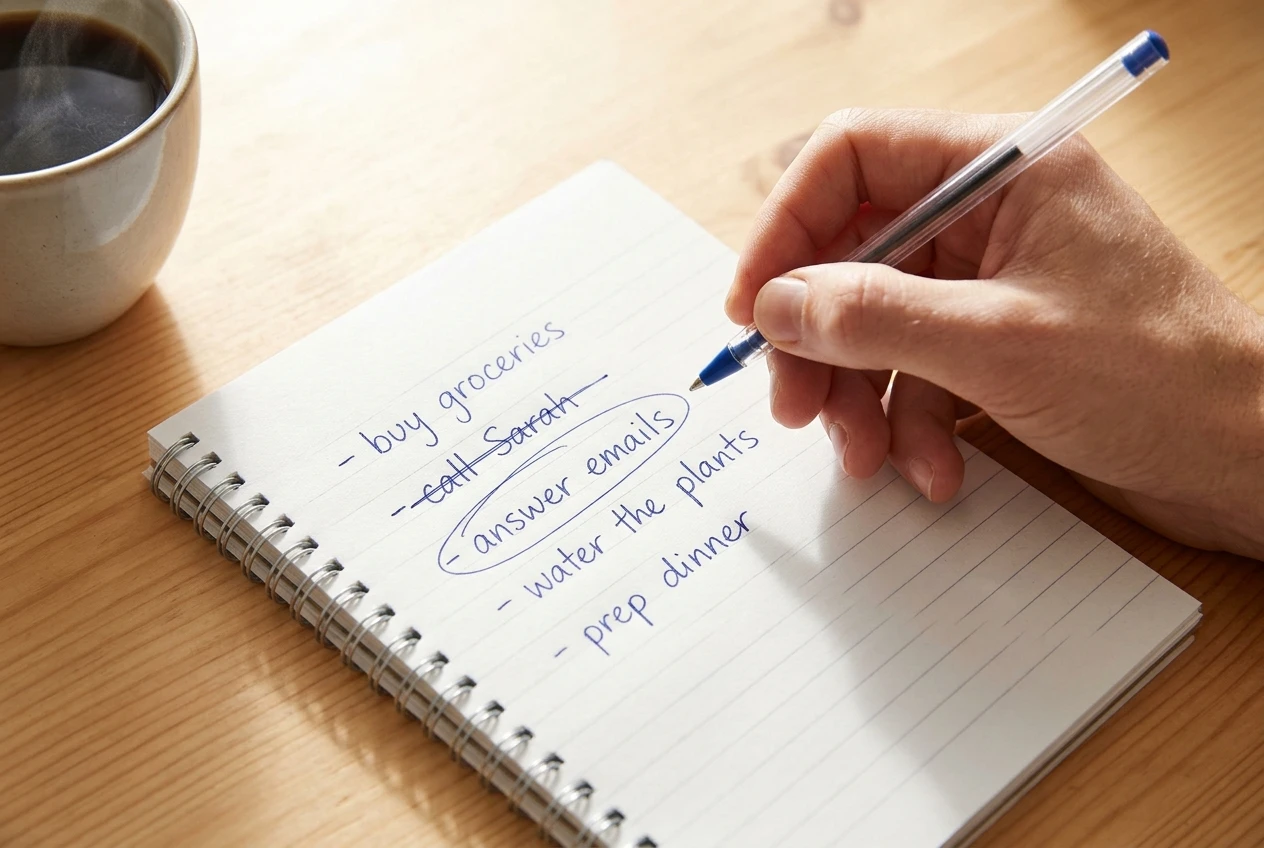
Step two: write down every action you could take next. Don’t sort yet. Just get them out of your head.
Step three: pick the one that the others depend on. If one action has to happen before the rest make sense, that’s your next move. Rewrite it so it’s small enough to finish in one sitting, and so you’d know when it was done.
Step four: finish it. Then cross it off. That crossed-off line is your proof of progress, and it’s the first thing a path is supposed to give you.
[B-roll: hands writing on a notepad, then crossing a line out]
What to do when the path stops fitting
Sometimes you’ll finish a move and the next one doesn’t fit anymore. Maybe you learned something that changed your plan, or your situation shifted. That doesn’t mean the path failed, and it doesn’t mean you start over.
Go back to the same exercise. Write down where you are now, including what you just finished. Look at the remaining actions and ask which ones still make sense. Drop the ones that don’t, add anything new, and pick the next dependency.

Everything you’ve already done still counts. A good path adjusts the order of what’s ahead of you and leaves what’s behind you alone.
If you adjust and still feel stuck, make the next move smaller. Most of the time, an action that feels impossible is really two or three actions bundled together.
[On screen: “Re-check where you are. Keep what’s done. Re-pick the next move.”]
Call to action
Pause this video and do the exercise right now. Write down where you are, pick the one action the others depend on, and finish it before you watch anything else.
Then tell me in the comments what your next action was. Putting it in writing makes you more likely to do it, and it might help someone else who’s stuck on the same decision.
If this was useful, watch the next video in this series, where we go through how to break a big goal into moves small enough to finish in one sitting.
[On screen: “Your next action: write it down, then finish it”]