
The second week is where many new affiliate marketers stop showing up. Nothing dramatic happens. A day gets skipped because it was busy, then another, and by the end of the month the site has not been opened in a while.
The cause is mechanical, and that is good news, because mechanical problems have mechanical fixes. This article covers how to build a daily routine for your online business that does not depend on how motivated you feel on a given morning.
Why the second week is where most routines quietly fall apart
The first few days of a new business run on novelty. Everything is new: the account, the dashboard, the first decisions about your site. New things hold your attention without any effort from you.
By day 10 to 15, the novelty has worn off. The work is now ordinary work, and the rewards have not arrived. There is no traffic worth mentioning and no commission. The effort goes in and nothing visible comes back.
That gap is the weak point. Your motivation was borrowed from novelty, and novelty runs out before results begin. A routine that relies on feeling like doing the work will fail on exactly the days when the feeling is gone.
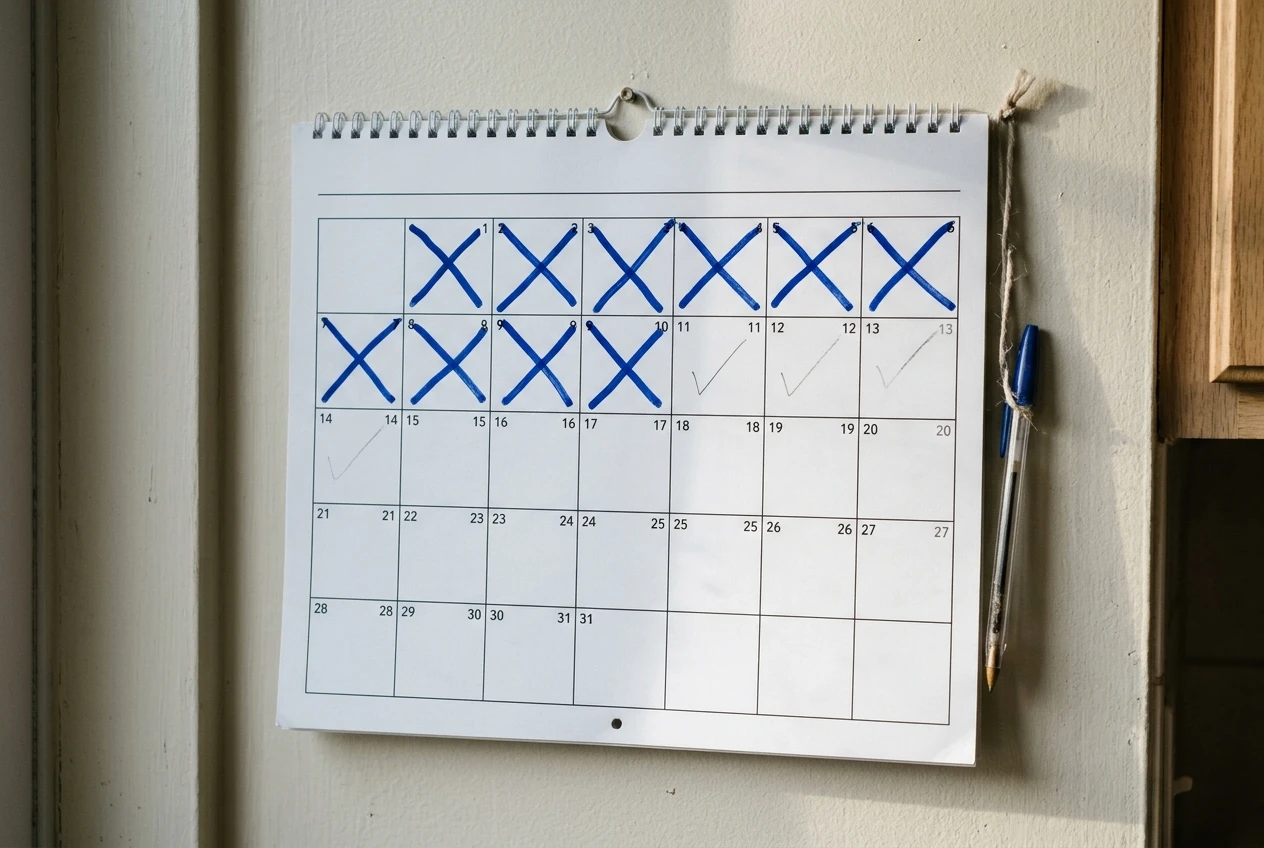
A second problem hides inside the first. Each time you sit down and have to decide what to work on, you spend a little energy before you have done anything. On a good day you barely notice. On a tired day that decision is enough to make you close the laptop.
So a routine that survives needs two things: a fixed slot that does not require willpower, and a task that is already chosen when you arrive.
Pick a daily slot small enough that you can’t talk yourself out of it
Most people set their first routine too ambitiously. They commit to two hours every evening, manage it twice, and then count the third missed evening as proof that they are not cut out for this. The routine was simply too big for a normal week.
Choose a slot you could keep during your most crowded week of the month. For most people that is 30 to 45 minutes. If that sounds too small to matter, remember that a small slot kept every day builds more than a large slot kept twice.
A good slot has four parts:

- One named task. Not “work on my site” but a single piece of work with a clear finish, such as “complete today’s task.”
- A set time. Attach it to something that already happens daily, like right after breakfast, straight after the school run or before you make dinner. A time tied to an existing habit needs less remembering than a time on a clock.
- A set place. The same chair, the same desk, the same corner of the table.
- A defined end. When the task is done or the time is up, you stop. Stopping on schedule makes it easier to start the next day, because the work never feels open-ended.
Write it as one sentence and put it somewhere you will see it: “Weekdays at 7:00, at the kitchen table, I do one task.” That sentence is your routine. Everything else in this article supports it.
Take the decision out of it: let Guided Path tell you what today’s task is
The most common reason people sit down and do nothing is not laziness. They open the laptop and cannot tell what to do first. Should they research keywords, adjust the site design, watch another tutorial or read the community feed? With no clear answer, any of those can fill the time, and none of them moves the business forward in a planned order.
This is where Guided Path earns its place in a routine. It lays out the work in sequence, so the next task is already chosen when you arrive. Your daily instruction becomes: open Guided Path, do the task it shows you, stop. There is nothing to plan and nothing to weigh against other options.
That changes what your slot has to do. It no longer needs you to feel inspired or organised. It needs you to show up, which is a much lower bar. If you want a closer look at what the first weeks inside it involve, this review of how Guided Path works for a beginner walks through it.
One practical habit helps. Before you finish a session, look at what the next task is, so that tomorrow’s session starts with something you have already seen. Knowing what is coming makes starting easier.
Write a bad-day version of your routine (the 15-minute floor)
Some days will be bad. You will be ill, tired, travelling or stuck in a day that ran over. If your routine has only one size, a bad day means a missed day, and missed days are how routines end.

Decide now, while you are calm, what the smallest acceptable version looks like. A workable floor is 15 minutes spent on the same task you would normally do. The rule is that you can stop after 15 minutes, but you must begin.
Write the floor down in the same place as your regular routine. Here is how it might look:
- Open the task and read it through to the end.
- Do the first part of it, even if you will not finish it today.
- Close the session by noting where you stopped, so tomorrow begins from that point.
A 15-minute session counts as a day done. This matters because a routine is a chain of days you showed up, and the length of each day matters far less than the chain staying intact.
Starting is also the hardest part of most tasks. Once you have begun, you often carry on past 15 minutes. If you do not, the day still counts, and you have lost nothing.
What to do the day after you miss a day
You will miss a day at some point. A routine that cannot survive a missed day will not survive a real life, so plan for it now.

The rule is simple: miss one day if you must, but do not miss two. One missed day is an interruption. Two in a row starts to feel like a new pattern, and the second is the one that is hard to recover from.
When you come back, do these things:
- Do the next task, not the one you skipped. There is no need to make up lost time. Doubling your session to compensate turns a minor miss into a large debt, and large debts are what people avoid.
- Use the 15-minute floor if you need it. Restarting is easier when the bar is low.
- Do not review the missed day. Skip the guilt and the calculation of what you lost. It cost you one day, and the path goes on.
- Check the slot if it keeps happening. If you miss the same day of the week repeatedly, the time is wrong, not you. Move the slot to a time that your week actually allows.
Because Guided Path already holds your place in the sequence, restarting does not require working out where you were. You open it, see the task, and begin.
How to tell the routine is working when there is no income yet
In the first weeks there will probably be no income to measure, so you need other evidence that the routine is doing its job. Look for these signs:
- You are showing up on most days. Count your sessions each week. A high count is the early result, and it is the one you control.
- Starting takes less effort. Early on, sitting down feels like a negotiation. After a few weeks it feels more automatic. That shift is the habit forming.
- You know what tomorrow’s task is. If you never have to wonder what to do, your routine has no decision left to fail on.
- Things are getting finished. Completed tasks and published work are real output, even before anyone reads them.
- Missed days are followed by return days. A routine that recovers is stronger than one that has never been tested.
Income, when it comes, follows a long stretch of this kind of work, and it arrives later than most people expect. For a realistic picture of the timeline, this piece on what your first 90 days should look like sets out what to expect and what not to.
Until then, judge yourself on what you can control. Whether you did today’s task is a fair question. Whether you earned money today is not, at this stage.
Where to go next: the plan for the stretch after day 30
If you keep the routine through the first month, you will have something most beginners lack: a working habit with the start-up cost already paid. The work in the following weeks changes in character, and it helps to know how before you arrive. This plan for the middle of your first 90 days covers what to focus on once the early excitement has gone.
For now, set up the routine in a single sitting. Write the one-sentence version, choose the slot, write the 15-minute floor, and decide that a missed day is followed by a return, never by a second miss. Then do the first session.
If you keep sitting down to work and not knowing what to do first, start with Wealthy Affiliate’s Guided Path, so each day’s task is already chosen for you and you can simply show up. Use the link on this page to join and begin with the first task today.