
If you have decided to join Wealthy Affiliate but have no idea what the first month should look like, this plan gives each week one focus and each day one small action. The Guided Path sets the order of the work. Your job is to show up, do the next piece, and stop when it is done.
This is a way to pace your first 30 days at Wealthy Affiliate, not a tour of the platform. If you still need help with the mechanics, the guide on creating your Wealthy Affiliate account covers sign-up, and the walkthrough of the dashboard for beginners covers the layout.
Before day one: what to expect from your first month
A first month is a foundation period. By the end of it you can reasonably expect to have a working routine, a Hub of your own, a site taking shape, and your first piece of content published. Those are things you control, so they make a better measure of the month than income does.
It helps to decide in advance what you will not judge yourself on. Traffic, rankings and commissions depend on many things outside your daily effort, and they usually take longer than 30 days to show a pattern. If you check them every morning in week one, you will feel behind for no good reason.
Two practical decisions are worth making now:

- Pick a daily time. Choose a window you can protect, even if it is only 20 to 30 minutes. The same time each day matters more than the length of any single session.
- Pick a place to work. A chair, a notebook and one open browser tab are enough.
If you want a clearer idea of what the Guided Path is before you begin, this piece on what a Guided Path really means explains why having an order to follow helps when you feel stuck.
Week one: get settled and take the first task on the Guided Path
The focus of week one is orientation. You are learning where things are and completing the first tasks the Guided Path gives you, nothing more.
Here is a simple daily rhythm for the week:
- Day 1: Open your Hub and look at what the Guided Path shows as your next task. Read it through, and do not start anything else.
- Day 2: Complete that first task, even if it feels small. Finishing something on day two sets the tone for the month.
- Day 3: Open Learn and look at the Focus you are on. A Focus holds Moves: things to Ask, Watch and Read. Do one Move.
- Day 4: Do the next task the Guided Path offers.
- Day 5: Do one more Move in your current Focus.
- Day 6: Revisit anything you found confusing. Re-reading is part of the work.
- Day 7: Rest, or spend ten minutes looking at what you finished this week.
You will notice there is no instruction to explore everything. A new member who clicks through every menu on day one often ends the week having finished nothing. Following the Guided Path removes that choice: the next task is already picked for you.
If you have not chosen a niche yet, you do not need to solve it in week one by yourself. The guide on picking your first niche using Wealthy Affiliate can help when the Guided Path brings you to that decision.
Week two: build the habit of showing up for a short, steady session each day
Week two is about repetition. The content matters, but the main goal this week is that opening your Hub at your chosen time becomes automatic.
A session of 20 to 30 minutes can look like this:
- Open and read (2 minutes). Look at your next task or Move. Say to yourself what it is.
- Do the work (15 to 20 minutes). Work on that one thing only.
- Close it out (3 minutes). Write one line in a notebook: what you finished and what comes next.
That last line is what makes tomorrow easy. When you sit down the next day, you do not have to decide anything. You read your own note, open your Hub, and continue.
Some days the work will go slowly. You may read a Move twice and still feel unsure. On those days, finishing the session counts as doing the day correctly, even if you finished little. A short session you complete is worth more than a long session you postpone until the weekend.

A few things tend to break a new routine in week two:
- Switching to a second course or video series because it looks interesting
- Reading about other people’s results instead of doing your own task
- Making the session longer on a good day and then skipping the next one
If you notice any of these, return to the one-task rule. One task, one session, one line in the notebook.
Week three: put what you learned into your own site and your first piece of content
By week three you have a routine and some knowledge. Now the work moves from taking in information to making something that belongs to you: your site and your first piece of content.
Follow the Guided Path for the exact tasks. What you do each day will depend on where it has taken you, but the pattern for the week can stay constant:
- Early in the week: Work on your site setup tasks. Take them one at a time, and do not redesign anything you have already finished.
- Midweek: Choose the topic for your first piece of content. Pick something simple that a person in your niche might genuinely search for. Your first article does not need to be your best one.
- Later in the week: Write it. Your Writer in Studio can help you draft, and you should read the draft aloud and fix anything that does not sound like you before you publish.
- End of the week: Publish, then stop. Do not reread it ten times.
Many people stall at this stage because they treat the first article as a test of their ability. It is better to treat it as a first draft of a habit. You will write dozens more, and the later ones will be better because you wrote this one.
Once you have published, you may want a rhythm for what comes next. A simple content calendar you can keep up with, one week at a time shows a manageable way to plan without overloading yourself.
If you want images for your piece, your Artist can create them in Studio. Keep it to one image for the first article, so the picture does not become the thing that delays publishing.
Week four: look back at what you finished and choose your next focus
Week four combines review with a decision. You spend the first half looking back and the second half looking ahead.
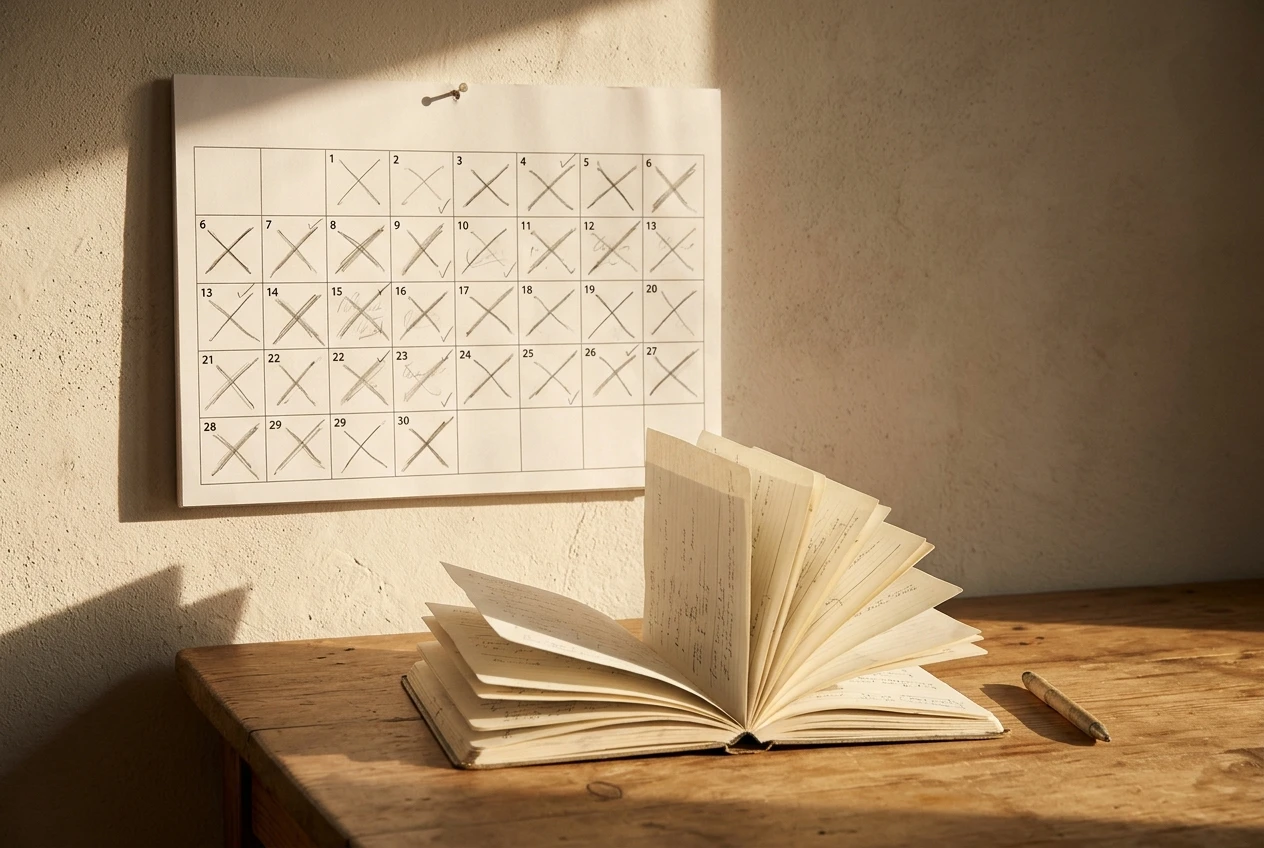
Days 22 to 24: review. Open your notebook and read your daily lines from the past three weeks. List what you finished: tasks on the Guided Path, Moves in your Focus, site work, and your first published content. Seeing it written down is more convincing than remembering it, because progress made in small pieces is easy to forget.
Days 25 to 27: notice. Ask yourself three practical questions:
- Which time of day worked best for my sessions?
- Which kind of task did I put off, and why?
- What would make my sessions easier next month?
The answers are useful. If you kept putting off the writing, schedule it for your best time of day. If you kept losing the thread midweek, shorten your sessions and add a day.
Days 28 to 30: choose. Look at what the Guided Path presents next and commit to it for the coming weeks. If you finished your first article, plan the second. Keep the same daily session, because the routine is what carried you through this month.
When you reach the point where the beginner tasks feel behind you, this piece on what changes when you stop being a beginner describes what to expect.
When you fall behind: how to pick the month back up without starting over
At some point you will miss days. Illness, work, family and ordinary tiredness all interrupt plans, and a 30-day plan does not pause for them. What you do next matters more than the gap itself.

Here is a way back that does not involve starting over:
- Do not make up the missed days. Doing three days of work in one sitting usually leads to a bad session and another skipped day.
- Open your notebook. Read your last line. It tells you exactly where you stopped.
- Open your Hub and find your next task. The Guided Path keeps your place, so you continue from where you left off, not from day one.
- Do a short session today. Ten minutes is acceptable. The aim is to restart the habit.
- Adjust the calendar, not the standard. If you missed a week, your 30 days become 37. The work is the same and the finish line has moved.
The day count is only a way to organize your effort. The real measure is whether you are working through the Guided Path in order, at a pace you can keep up. Falling a few days behind does not undo what you finished.
A simple daily checklist to keep beside you for all 30 days
Copy this onto a card or into a notebook and use it every day.
Before you start
- Is it my usual session time?
- Have I read my note from yesterday?
- Is my Hub open on the next task or Move?
During the session
- Am I working on one thing only?
- Have I ignored other tabs, courses and ideas for now?
- Am I stopping when the task is done, not when I run out of energy?
After the session
- Did I write one line about what I finished and what is next?
- Did I close my Hub, so tomorrow begins fresh?
Once a week
- Did I do a short review on day seven?
- Did I check that my next task is still the one the Guided Path suggests?
On a bad day
- Did I do at least ten minutes?
- If not, can I do ten minutes now?
The checklist is short deliberately. A longer one becomes another thing to fall behind on.
Start your 30 days on day one
The first 30 days at Wealthy Affiliate go best when you start with a plan and let the Guided Path decide what comes next. If you are ready to stop wondering what to do and begin working through it one piece at a time, join Wealthy Affiliate and begin the Guided Path on day one.
I earn a sign-up commission if you join through my link, as described in my affiliate disclosure. That does not change what the plan above asks of you, which is a short session each day and a note to yourself at the end of it.