
If you have been working on your online business alone for weeks and still feel lost, you have probably asked yourself whether you should keep pushing or ask someone. Knowing when to ask for help with your online business is a skill, and nobody teaches it. Most beginners learn it by waiting far too long.
This article gives you a short list of signs and one simple rule. Together they let you decide on purpose, so asking feels like a sensible move and not an admission that you are not cut out for this.
Why struggling alone for a long time isn’t a sign of strength
Many beginners believe that figuring everything out alone proves they are serious. It sounds sensible, and it falls apart as soon as you look at what the time is being spent on.
When you are new, most of your stuck moments have short answers. A setting is in a different menu than you expected. A step is missing from your instructions. A term means something other than what you assumed. Someone who has done the task before can answer in a few minutes. You might spend three evenings on the same problem and still not find it.
Those evenings are not wasted because you lack ability. They are wasted because the problem is a missing piece of information, and persistence does not produce information you do not have. Effort and intelligence help when the answer can be reasoned out. For a lot of beginner problems it cannot.
There is a cost beyond lost time. Each week of going nowhere makes it easier to decide the problem is you. That conclusion is usually wrong, and it is the one that makes people quit. Asking earlier protects you from it.
So the useful question is how to tell the difference between a problem worth wrestling with and one that needs another person. These three signs answer that.
Sign one: you keep reopening the same task and never finishing it
Look at your task list or notebook. If the same item has been there for several days, and you open it, work on it a little, and close it again without finishing, that is the first sign.
It might be setting up your site, writing a first post, or choosing a niche. The task does not have to be hard. What matters is that you keep returning to it without getting through it.
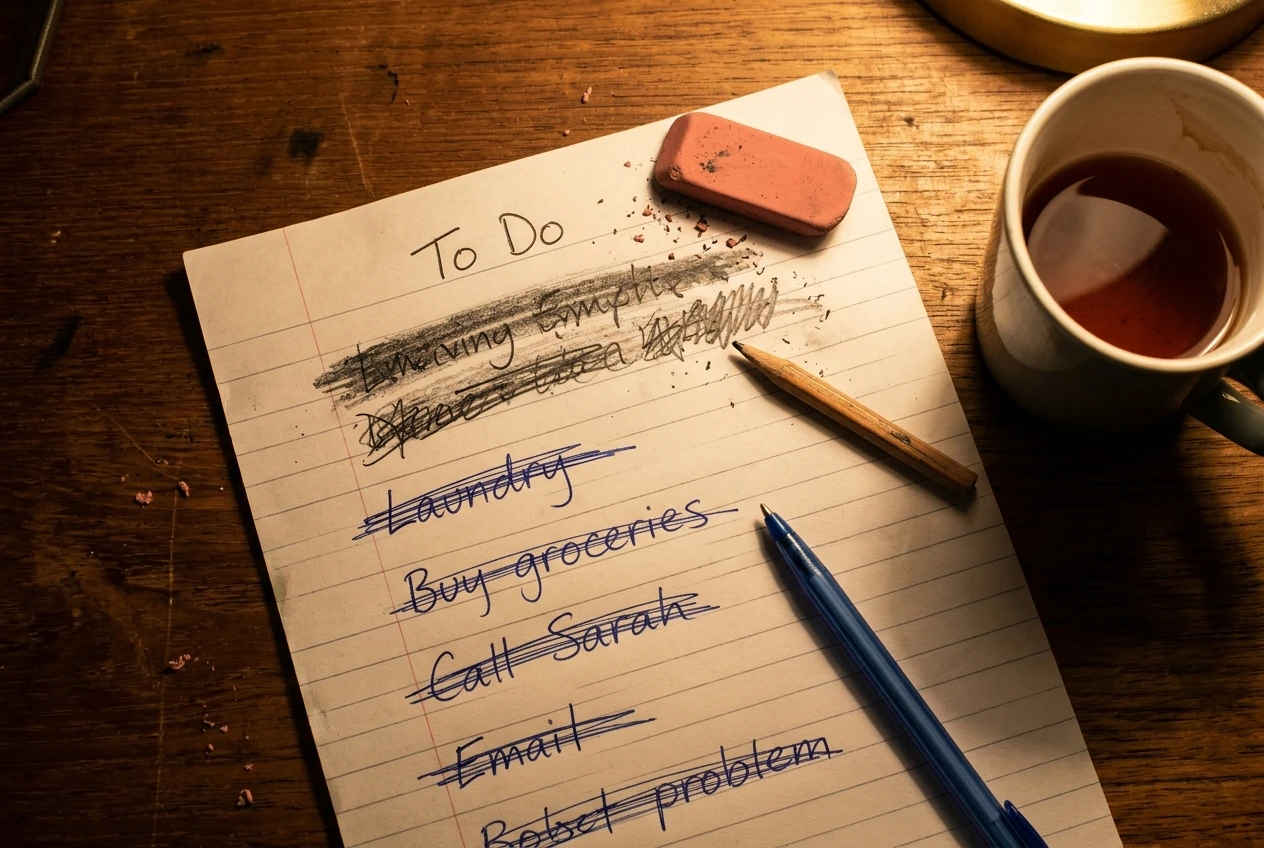
A task stays open like this for one of a few reasons:
- You are missing one piece of information and do not know which one.
- The task is too large and has no clear first action.
- You are not sure what “done” looks like, so you keep adjusting it.
All three are solved faster by a conversation than by another evening alone. A person looking at the task can usually tell you which of the three it is within minutes. If you recognise this pattern in your own work, the article on why you are still planning instead of starting covers how to pick the smallest next step.
A quick test: if you can say “I have been on this for three days and cannot say what is left to do,” the task needs a second pair of eyes.
Sign two: you can’t tell whether what you’ve built is right or wrong
The second sign is quieter. You finish something, such as a page, a post, or a site layout, and you have no way to judge it. You look at it and cannot say whether it is good, acceptable, or off in some way you cannot see.
Beginners are especially exposed to this because they have no reference point yet. An experienced person sees a page and notices that the title is vague, or that the topic is too broad, or that the structure leaves the reader without a next step. You cannot notice these things yet, because you have not seen enough examples to compare against.
Without feedback, you have two bad options. You can publish everything and hope, or you can keep polishing and never publish. Both leave you where you started.
Work with no way of checking it is a clear reason to ask. You are not asking whether you are talented. You are asking for a check against a standard you do not have yet. Sometimes the answer is “this is fine, move on,” and that answer is worth a lot. It lets you stop revising and start the next task.
Sign three: you’re collecting new tutorials instead of acting on the last one
Watching or reading one more tutorial feels productive. It is also a comfortable way to avoid doing something you are unsure about.
Check your recent days. If you have opened three or four new guides, videos, or courses and applied none of them, that is the third sign. The pattern usually means you do not trust that you know enough to start, so you look for more information. More information from different sources often contradicts the last, which leaves you less certain, and so you search again.

The way out is to choose one source and follow it to the end. If the pile of advice keeps growing and nothing in your project has changed, you need someone to tell you which advice applies to you now and which can wait. For a closer look at what happens when you commit to a single route, see what changes when you finally follow one path.
A tutorial answers a general question. Your situation is specific, and that is where a person can help in a way that content cannot.
A simple time-box rule: how long to try before you ask
A time-box is a limit you set before you start working. When the time is up, you stop and ask, whatever your mood. Deciding in advance matters because in the middle of being stuck you will always feel that the answer is a few minutes away.

Here is a starting point. Adjust it to fit your own pace.
- Small task (changing a setting, fixing a formatting problem, finding a menu): 30 to 45 minutes.
- Medium task (writing a page, setting up a section of your site): one full working session, plus a short second attempt the next day.
- Large task (choosing a direction, planning a structure): two working days.
Before you ask, check that you have done these three things:
- Written down what you tried, so you are not repeating it.
- Searched once for the specific problem, not the general topic.
- Taken a short break and looked at it again with fresh eyes.
If the clock runs out and all three are done, ask. You have put in honest effort, and continuing is now just delay.
There is one exception. If you are learning a new skill and the struggle is the practice itself, such as writing your tenth paragraph or working out how to structure an outline, give it more time. Asking is for missing information. Repetition builds skill, and only you can do it.
Write the limit next to the task when you start. A number on the page is harder to argue with at the end than a feeling.
How to ask so you get a useful answer, not a pile of opinions
A vague question gets vague answers. “I’m stuck on my website, any advice?” invites ten different people to tell you ten different things, and you end up where you were, with more noise.
A specific question gets a specific answer. Use this structure:
- What you are trying to do. One sentence about the goal.
- What you did. The steps you took, in order.
- What you expected and what happened. The gap between the two is the problem.
- What you have already ruled out. This saves the other person from repeating your steps.
- Your actual question. One question, phrased so it can be answered.
For example: “I am trying to publish my first post. I wrote it, formatted the headings, and pressed publish, but the page shows without my headings. I expected them to appear as I formatted them. I checked the preview and they show there. Do you know why the published version differs?”
Compare that with “my post looks wrong.” The first can be answered in one message. The second takes several messages of back and forth before anyone understands the problem.
Two more habits help. Ask one question per message, so that answers do not get tangled. And ask someone who has actually done what you are trying to do. Advice from a person who has not built what you are building sounds confident and often misses the detail that matters. If you are not sure who qualifies, how to find a mentor online who is actually worth following goes through it.
When the answer arrives, try it before replying with more questions, and then report what happened. People help more willingly when they see their advice was used.
What changes once someone who has walked the path is beside you
The practical difference is speed. Problems that took days take minutes. The tasks you kept reopening get closed, because someone points to the missing piece or breaks the task into a first action you can finish today.

The second difference is order. A beginner working alone often does tasks in the wrong sequence, spending a week on something that belonged in month three. Someone who has been through the process can tell you what to do now, what to leave for later, and what to ignore. That removes much of the confusion that made you doubt yourself.
The third difference is steadier judgment. When you can check your work against someone’s experience, you stop second-guessing every decision. You publish, see what happens, and adjust. Progress is easier to keep up when you are not the only person assessing it.
None of this removes the work. You still write, build, and publish. What goes away is the long stretch of guessing between one task and the next, and the habit of reading that stretch as proof that you are not capable.
If you have been alone with this for a while, take the three signs as a checklist. Tasks you keep reopening, work you cannot judge, and a growing pile of tutorials you have not used are all reasonable grounds to ask for help. Set a time limit on your next problem and ask when it runs out.
If you recognised yourself in these signs, read what Guided Path actually means, and if it sounds like the direction you have been missing, join me inside Wealthy Affiliate through my link so I can walk it with you.