
When you publish more, your posts tend to sound more alike. If you want to know how to keep your voice when creating more content, the answer starts before you write the next post. It starts with understanding what your voice is made of, writing it down on one page, and checking each draft against that page before it goes live.
This piece walks you through that process step by step. You do not need a style guide or a branding course. You need a few of your own posts, a pen, and about an hour.
Why your voice slips right when you start publishing more
Your voice slips because of how you work once the pace picks up. A first post usually gets slow, careful attention, and the sentences come out of how you actually think. By the tenth post you are looking for ways to go faster, so you start borrowing.
Borrowing takes a few forms: opening with the same phrases you see on other sites, copying the structure of a post that ranks well, or accepting a first draft from a tool because it reads cleanly. Each shortcut is reasonable on its own. Together they push your writing toward the average of everything you have read, and the average has no personality.
Readers notice this before they can say why. A post can be accurate and well organised and still feel like it came from nobody in particular. That feeling is what makes a visitor leave and not come back.
The fix is not to slow down. It is to decide in advance what “sounds like you” means, so that you can check for it quickly.
Find your voice in the posts you already wrote, not in a list of adjectives
Most voice advice asks you to pick three adjectives: friendly, professional, authentic. Those words describe almost every website, so they tell you nothing about yours. They are also hard to apply. You cannot read a sentence and decide whether it is “authentic enough.”
Look at your own writing instead. Gather three to five pieces you wrote that you were glad to publish. They can be blog posts, emails, a long message to a friend, or a forum reply you put effort into. Choose the ones where you read them back and thought, yes, that is how I would say it.
Then read them with a pencil and mark what repeats:

- Sentence length. Do you write short, direct sentences, or longer ones that build toward a point?
- Openings. Do you start with a question, a plain statement, or a small example?
- Words you reach for. Notice the everyday words that keep showing up, and the way you name things.
- How you address the reader. Do you say “you” often? Do you give instructions, or do you suggest?
- What you leave out. Some writers never use exclamation marks or jargon. That absence is part of the voice.
If you have only one or two posts so far, that is enough to start. Add more later as your site grows. If you have nothing written yet, record yourself explaining your topic to a friend for five minutes and transcribe it. The transcript will show you how you really phrase things.
Build a one-page voice sheet you can actually use
A voice sheet is a single page you can read in under a minute. If it runs longer, you will stop opening it. Build it from what you marked in the previous step, and keep each section to a few lines.
Here is a layout that works:
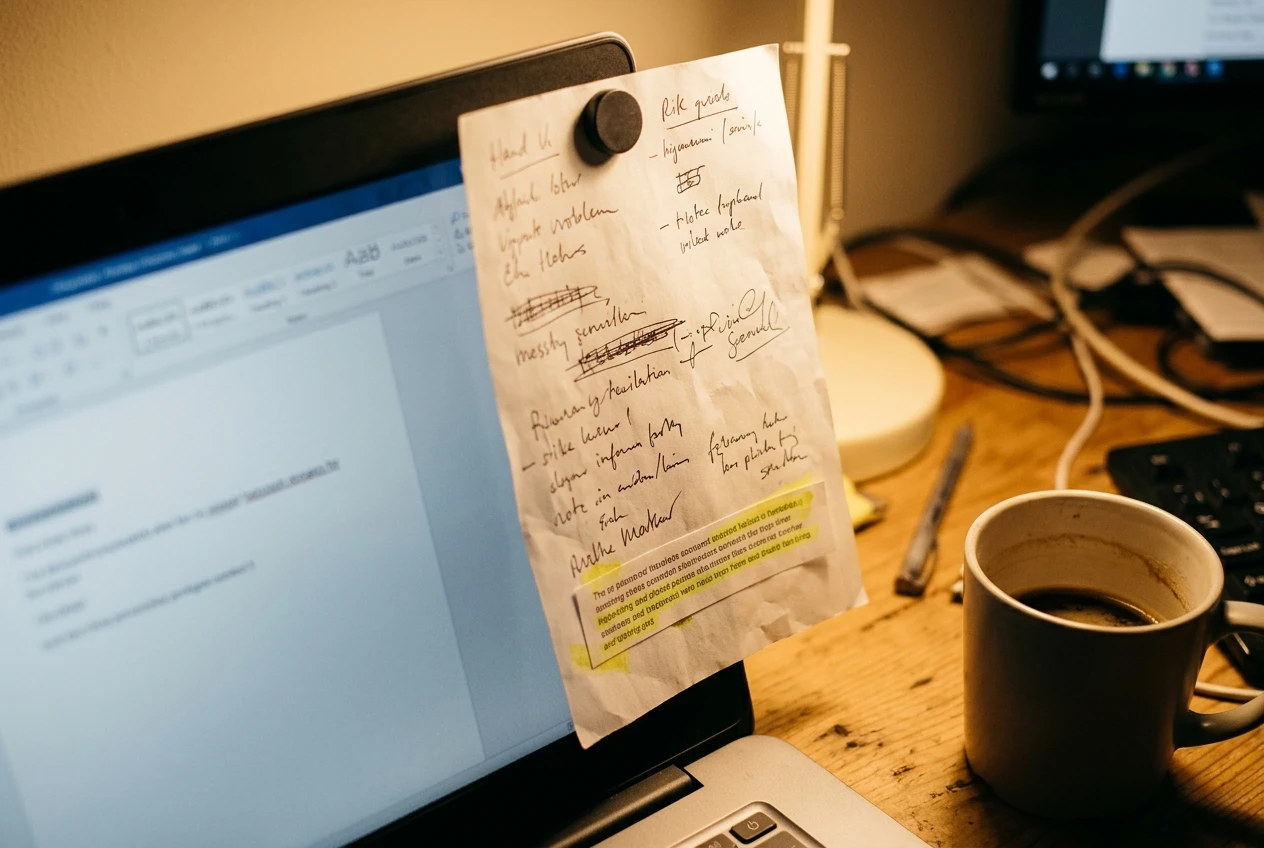
- How I sound in one sentence. Write it in plain words, such as “I explain things the way I would across a table, in short sentences, with one example per point.” Skip the adjectives.
- Words and phrases I use. List six to ten that came straight from your marked-up posts.
- Words and phrases I avoid. These might be corporate phrases, hype words, or anything that makes you wince when you read it aloud.
- How I open a post. Copy one or two real openings from your best writing as models.
- How I talk to the reader. Note whether you say “you,” whether you give direct instructions, and how formal you get.
- One paragraph that sounds most like me. Paste it in whole. This sample is the most useful part of the page, because it gives you something to compare against, not a description to interpret.
Keep the sheet where you will see it when you write: pinned beside your editor, or saved as the first note on your phone. Update it every month or so. Your voice changes as you write more, and the sheet should follow it.
Where a template helps and where it flattens you
Templates are useful, and you do not have to give them up. The question is which parts of a post a template should control.
A template helps with structure. A repeatable order for your headings, a standard place for your call to action, and a checklist for links and images all save time and do not touch how the writing sounds. If you are building a steady publishing habit, this is where a system pays for itself. The process side is covered in the one-page workflow that keeps a new creator from drowning in tools, which is a good companion to this piece.
A template flattens you when it supplies the sentences. Pre-written intros, stock transitions, and fill-in-the-blank paragraphs all produce text that fits every site equally well. Once those sentences are in your post, no reader can tell your site from any other.
A simple rule: let the template decide what goes where, and write every sentence yourself, in your own words. Use the template for the skeleton and your voice sheet for everything that fills it in.
A five-minute read-aloud check before you hit publish
This check is the part you will use most. It takes about five minutes and catches most problems.

Read the full draft aloud at a normal speaking pace. Your ear catches things your eye skips. As you read, stop at any of these:
- A place where you stumble. The sentence is probably too long or too stiff. Rewrite it the way you would say it.
- A sentence you would never say to a person. If it sounds like a brochure, replace it.
- A word from your “avoid” list. Swap it for one from your “words I use” list.
- A paragraph that could appear on any site in your niche. Add something specific to your topic: a concrete example, a number you have verified, a detail only someone who knows the subject would include.
Then do two quick comparisons. Read your opening paragraph next to the sample paragraph on your voice sheet. Do they sound like the same person? Then read your last paragraph. Endings are where people most often slip into generic encouragement, so check that yours says something concrete.
Fix what you flagged and publish. You do not need to polish every line. You need to remove the lines that are not yours.
What to do when a post still sounds like someone else
Sometimes you run the check and the whole draft feels wrong, not just a line or two. This usually happens when the draft started from somewhere else: a source you were summarising, a competitor’s article, or text a tool produced for you. The structure and phrasing of the original stay in your head even when you reword them.
Rather than patching sentence by sentence, try this:
- Close the draft and reread your voice sheet, especially the sample paragraph.
- Write the main point of each section in one plain sentence, from memory, without looking at the draft. That version will sound like you.
- Rewrite the opening and the closing from scratch. These carry most of the tone.
- Cut any sentence that does not add information. Filler is where borrowed phrasing hides.
- Run the read-aloud check again.
If the post still resists, it may be about a subject you have not yet worked out your own view on. That is useful to learn. Spend a little time with the topic, decide what you think, and then write.
Also note which sources or tools produce drafts that need the most rewriting. Over time that tells you where to start from, and when to start from a blank page instead.
How to bring your voice onto YouTube without writing a script word for word
Your channel intent includes video, and voice matters even more there, because viewers hear you directly. A word-for-word script often makes people sound stiff, because written sentences and spoken sentences have different rhythms.

A looser approach keeps you sounding like yourself:
- Write an outline, not a script. List the main points in order, with one example or detail under each.
- Script only the first sentence. A clear opening line settles your nerves and sets the direction. After that, talk through the points.
- Use your voice sheet’s phrases. The words you listed as yours are the ones that come out naturally when you speak.
- Record a rough take first. Treat it as practice. Listen back for sections where you sound most like yourself and note what you were doing differently there.
- Use the transcript. If your video tool produces a transcript, read it against your voice sheet. It shows you how you actually phrase things, which can improve the sheet itself.
The same read-aloud habit carries over. A post that passes the read-aloud check is already close to how you would say it on camera, so a good article can become the outline for a video on the same topic.
Keep going, one post at a time
Publishing often and sounding like yourself are compatible, provided you give your voice a place to live outside your head. The sheet and the five-minute check are small enough to use on every post, which is how they stay useful once the pace picks up.
If you want someone to walk the path with you while you build the habit of publishing, take a look at how the Guided Path inside Wealthy Affiliate lays out your next step, so you are never guessing what to write or do next.